14 September 2026 · 18:00 · The Phoenix Rooms
Naval and Military Conclave No. 35
Yesterdays adventure...
- Venue
- Portsmouth
Time once again for the Knights of Holy Rood Red Cross of Constantine No. 319 to brave the lower end of Portsmouth and pay a visit to Naval and Military Conclave No. 35, once one has located a nearby parking space.
I must begin by congratulating Portsmouth as it celebrates the centenary of being granted city status by the UK Government in 1926. Portsmouth was founded around 1180 by Jean de Gisors on Portsea Island and received its first royal charter from King Richard I in 1194, establishing it as a town. So, doing the maths, it took 746 years to become a city - which makes modern Masonic decision-making look positively speedy.
Henry VIII later turned Portsmouth into a major naval base. In 1545, he watched the Mary Rose sink in the Solent - an awkward moment which probably didn’t spoil his dinner. History later brought the ship back as one of the city’s most famous attractions, proving that even a spectacular maritime mishap can become a gift shop if you give it long enough.
During the age of sail, Portsmouth became the beating heart of the Royal Navy. Nelson’s flagship, HMS Victory, still sits in dignified splendour at the Historic Dockyard, looking remarkably composed for a vessel permanently surrounded by tourists with their camera phones.
Bombed heavily during the Second World War, Portsmouth rebuilt itself with characteristic stubbornness. Today it combines naval tradition, football, Isle of Wight ferries, students and the Spinnaker Tower—a giant sail-shaped landmark confirming that, even if Portsmouth cannot launch something that doesn’t sink, it will at least build it upright and charge admission. In short, the city has spent more than 800 years defending Britain, launching vessels and explaining, with increasing firmness, that it is definitely not Southampton.
Interesting fact: Arnold Schwarzenegger lived and trained in Southsea for a short time during the late 1960s. Presumably, after mastering bodybuilding, he decided the seafront wind was a bit chilly and left for Hollywood.
Having entered through the mysterious door in the wall, I can now report on the meeting. It was an Official Visit by the Intendant General, R. Ill. Kt. Steven Groeger, which made everyone stand very straight as he entered beneath the customary Arch of Steel. He then took the chair, confirmed the minutes and delivered the usual parish notices in his usual relaxed manner. As there was no Candidate that evening, the IG presented his lecture, ‘Was Constantine the Great a Good or a Bad Person?’ A definitive answer proved elusive, largely because it all happened in the fourth century and long before social media. On the credit side, Constantine did much to promote Christianity, he helped reunite the Roman Empire, strengthened the army and commissioned enormous building projects. On the debit side, he fought wars, disposed of people he disliked and bumped off members of his own family.
So, in the final analysis, was he good or bad? For a Roman emperor, I think he did all right. The competition was not especially fierce, and the complaints procedure was poorly advertised, but I quite liked him!
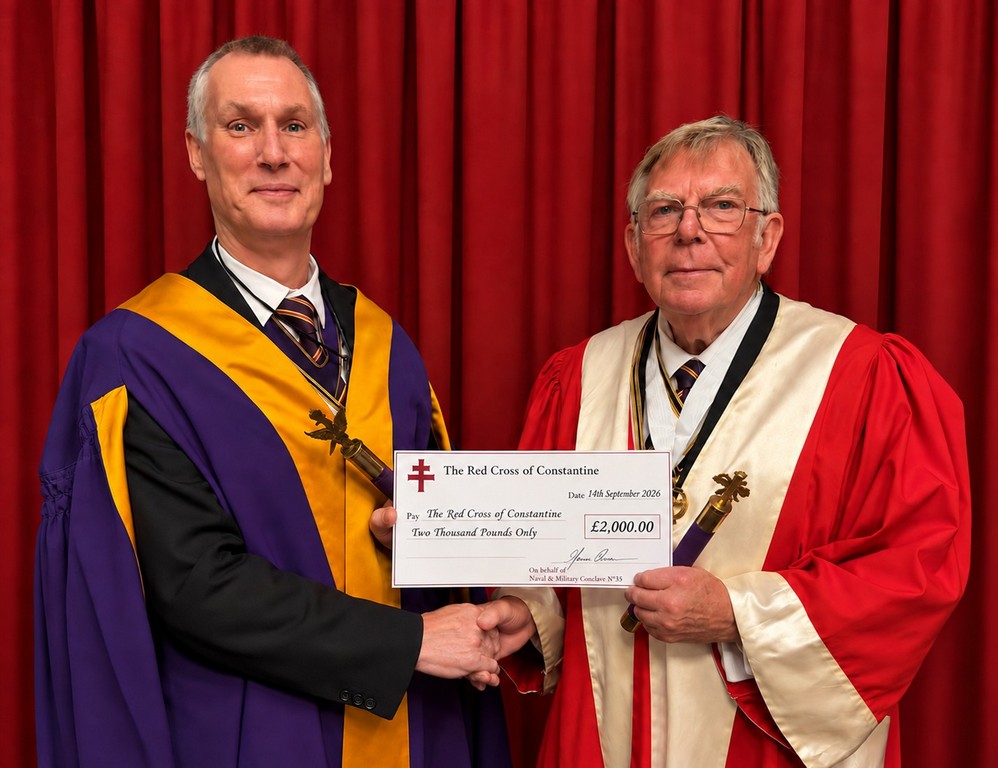
The Conclave then presented the IG with a donation of £2000. A sum of £1000 to go to the Grand Sovereigns Charity ‘Care for Children’ and another £1000 to the Divisional Benevolent Fund.
Driving home afterwards, one is left to ponder the watchwords of the Order - Faith, Unity and Zeal, and to look forward to another visit to the UK’s only island city, assuming Portsmouth has not raised the drawbridge by then.